
I highly recommend reading the guides to the pull-up and the toes-to-bar first, since much of their foundation is needed for the bar muscle-up.
1. Master the basics
This is one of my mantras, because it cannot be said enough. Over and over I need to take clients back to easier exercises so they understand the task.
An analogy: master a solid hang snatch before you snatch from the floor.
Basics are methods and principles that carry over to every movement in the same family. Becoming a master of the beat swing, for instance, is so often overlooked: people progress past it thinking "I got this, let's move on".
No. You are never done with the basics. Let it sink in. You should practise some basics in every session for the rest of your life.
2. Strength requirements
There is no exact science on how much strength a bar muscle-up takes, but I have noticed that athletes with 5 or more strict pull-ups have an easier time getting it.
You need strength in the lats, biceps and triceps, to name a few. You need power in your kipping pattern, so the hip flexors and abs are definitely involved.
You should be able to do single bar dips through the full range of motion, since that shows both your strength and your mobility. If your bar dips are not there, you will chicken wing the movement: you will not master it, and you risk getting injured.
3. Technique requirements
Ten good kipping toes-to-bar, built on a solid beat swing, is a good platform for developing a bar muscle-up. By solid I mean something like this:
Exercises
Now let's go through the exercises that will help you most.
Box-assisted bar muscle-up
This drill teaches part of the transition. It also reduces the fear of what happens once you get around and above the bar. Believe me, that is no small thing.
Choose a box height that makes it a notch challenging to get over the bar.
Single bar dips
You need to be able to do single bar dips to get through the transition without fear and without chicken winging.
A common mistake is to forget to start with high hips. Let the hips rise, then bend the arms, or you will have the wrong angle and too little range of motion.
Band-assisted bar muscle-up
I am not a big fan of the band under the feet. I prefer the band attached above, which makes the movement more technical and closer to the real thing. Choose a band that lets you do three solid bar muscle-ups, ones that would impress me. No chicken winging allowed.
Over time you may be able to use a lighter band and still get three, or do one or two technically perfect reps. The videos show both versions; I prefer the second one.
Keys:
- Tight kip, intense lats.
- Be patient with the arm bend.
- Feet high is excellent, as long as you can come back.
Bar muscle-up between boxes
Nailing this drill gets you close to the real thing, since the boxes only help you get momentum for the kip.
Set up two boxes so you can stand on them and grab the bar in a good hollow position. Without hopping or changing posture, release the feet, gather them and swing into a strong arch, which you then forcefully reverse.
Be patient about when to pull with the arms. When the arms bend, the power ends, and that is the most common problem on the way to solid bar muscle-ups.
Pull when the hips are right under the bar. If you pull before that, you only pull your chest into the bar.
Front lever
Front levers are not common in functional fitness, but I think they are excellent: they teach you how to activate the lats and they are great hanging core exercises. They also build all-round fitness, and I believe a strong shoulder girdle helps you stay clear of kipping injuries. That is why I include them in my training plans.
Tuck front lever
The tuck is a reasonable variation at this strength level. Pull back with the lats as in the video, then ball up into a tuck. Push yourself as far back as you can instead of hanging passively under the bar. Your lats should burn.
Straight-arm banded bar muscle-up
This final exercise refines the feel for when to pull around the bar. It came from my realisation that all these gymnastics movements are basically straight-arm lat pull-downs.
Put a medium band across the rig, attached to J-cups or similar at about armpit height. That gives you a good range of motion. Keep the body as rigid as you can. Use the lats to push hard into the bar before you even think about bending the arms.
The band pushes you back and lets you practise the timing of when to pull around and over.
The bar muscle-up
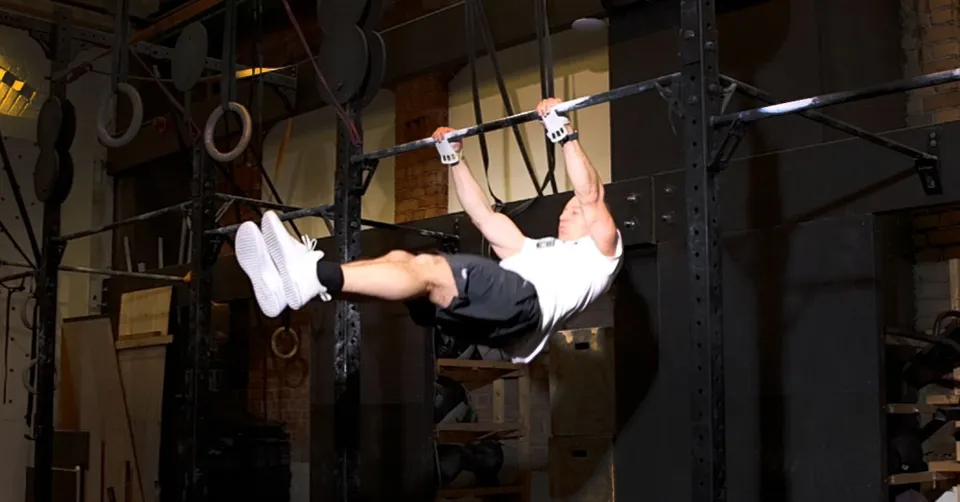
Look at the picture above. That is the point where I start pulling with my arms.
Watch the bar muscle-up in slow motion for a final feel for it. Notice that it is basically a really big beat swing that turns into the rise of the hips.
On to the ring muscle-up
On the rings, practise both the false grip and the regular grip. The straightest way to a single ring muscle-up is to master the false grip and get stronger. To get to five, it is much easier to learn the kipping mechanics.
Key points for the foundation of a ring muscle-up:
- A strict weighted pull-up with 20 % of your body weight or more.
- 5 or more strict ring dips.
- Mobility at the bottom of the ring support and in the transition. The chest and mid-back are often what limits you.
Did you get it?
Hopefully you now understand the foundation of the third kipping gymnastics movement, the bar muscle-up. Now you need practice to get it.
Questions? Email us at hello@relentlessmethod.com.